Showing posts with label Darwin's Doubt. Show all posts

Thursday, 28 July 2016

Responding to a Biology Professor: Common Descent is a Fact! The Only Disagreement is Over the Mechanism

Here's a discussion I had with a Biology Professor who specialises in Palaeontology.

This was the contention she put to me:

"The only disagreement in the scientific literature is about the mechanism, and that is simply healthy scientific discourse, which changes as the available information changes. There is zero disagreement about the reality of common descent".


Before I continue I will note that she wrote this as well in that same post:
"Neo-Darwinism has been dead for half a century."

This is significant because the Neo-Darwinian paradigm is still currently accepted by most scientists. Yet while she evidently disagrees, she believes that some as yet unknown evolutionary mechanism can account for the complexity of life.

I wrote (in response to her):
""The only disagreement [over common descent] in the scientific literature is about the mechanism". 
Shouldn't the mechanism be the thing that proves common descent? Otherwise common descent would be presupposed without any explanatory power to show how it is possible. 
So basically the fossil record, which contradicts Darwinism (and where any contradictions are explained away or are asserted to prove it anyway) actually proves Darwinism?

Also, Palaeontology is really good for coming up with up nice stories about how things could be, but it is unsupportable without an adequate mechanism (which you've presupposed exists). You need a mechanism FIRST, only then would Palaeontology back up Darwinism. The fossil record also isn't convincing because it does not contradict ID. So without an adequate mechanism it is totally arbirtrary to say it proves Darwinism.

Oh and if you believe the similarity of DNA between different animals proves molecules to man evolution - it is also a presupposition because no mechanism is adequate to prove that it indicates common descent (is possible). Similarity of DNA likewise doesn't contradict an ID perspective so using it as evidence is a mere assertion.

(This is only my personal viewpoint in looking at the evidence - other ID theorists such as Michael Behe find Common Descent plausible - I do not.)"  


This was her response (note: she made some irrelevant points which I have excised):

""Shouldn't the mechanism be the thing that proves common descent?" 
No. The Germ Theory of Disease proposed that many diseases are caused by microorganisms. We still don't know the precise mechanism in all cases, but nobody doubts the veracity of the theory. 
"Oh and if you believe the similarity of DNA between different animals proves evolution - it is also a presupposition because no mechanism is adequate to prove that it indicates common descent" 
Hm --- tell that to the forensic police departments all over the world. If DNA similarities do not show relationship, then we're all in trouble, because there would be no evidence that children were related to their parents. 
Tell us, what *does* similarity of DNA show if not relationship? If it's simply random, then why isn't my great great great great great great great grandfather a cactus rather than Charlemagne?"


- Note the classic bait-ands-switch technique!


And my response:

"All your examples use minor change within species as a bait-and-switch to explain all the supposed change from molecules to man. This is not an evidence-based comparison. The mechanism is known and sufficient to explain change within species. So how could  you use known mechanisms as evidence for something that defies explanation through those same mechanisms? 
I am talking about common descent, not change within species or DNA similarity within a species. Using germ theory is a false comparison as, for example, you assert that the mechanism is only not known "in all cases". Where as the mechanism for explaining molecules to man evolution is not known at all. ID constitutes a better explanation than a Neo-Darwinian mechanism. Hence why there is no need to resort to a hypothetical mechanism."


Note: I did not respond to this point - "Tell us, what *does* similarity of DNA show if not relationship?" - because in passing it appeared to be just an assumption. But I will address it for any who want clarification. The similarity can easily be attributed to Common Design. Just like how a car designer might create different car models but they are still building on a basic design template.

Further, the evidence shows that there are many unique genes that cannot be explained through the possibility of common descent. A group of German scientists recently examined the gene sequences of 16 different Cyanobacterial strains in an effort to discern all the distinct kinds of genes these strains carry. They found that they do share a common set of 660 genes (not identical genes but similar enough to encode for proteins). But surprisingly they found that nearly 14,000 genes are unique to individual strains (at an average of 869 unique genes per strain)!* These findings indicate that those bacterial strains are more genetically different than alike, despite their overall external similarities. This flies in the face of what you would expect from common descent.


Stephen Meyer, writing in Darwin's Doubt sums up my argument nicely when he says:
"The Darwinian formulation of evolutionary theory in opposition to the design hypothesis, coupled with the inability of Neo-Darwinian and other materialistic theories to account for the salient appearances of design, would seem to logically reopen the possibility of actual (as opposed to apparent) design in the history of animal life" 


Another commenter had this interesting point to say:
"How can one understand Darwinian logical fallacies?
Evolution is an anti-science theory based on a lie stating that life from non-life is possible.  
There's NO observational or empirical data, NO rigid mathematical model [and] NO large scale computer simulation or digital life research program confirming evolution. There's NO known observable process by which new genetic information can be added to an organism's genetic code resulting in speciation."


Random final addition - Why ID is Theoretically Falsifiable:

ID's claim that intelligence is the only thing capable of producing specified complexity is also technically falsifiable because if an undirected natural cause were capable of producing specified complexity then its claims would be disproven.


Fin.


Quote from: Meyer, Stephen C. Darwin's Doubt: The Explosive Origin of Animal Life and The Case for Intelligent Design. New York: HarperOne, 2013.

* C. Beck et al., "The Diversity of Cyanobacterial Metabolism: Genome Analysis of Multiple Phototrophic Microorganisms," BMC genomics 13 (2012): 56.



Wednesday, 27 July 2016

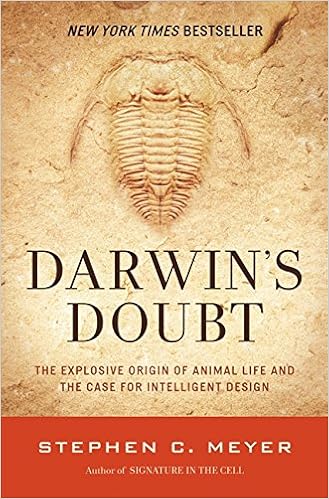
Thoughts on the Masterpiece that is Darwin's Doubt


This Masterpiece is Stephen Meyer's follow up to the acclaimed book 'Signature in the Cell'. Meyer's central thesis is that, due to the indisputably short time frame for the Cambrian explosion (a blink of the eye in the earth's history), only intelligence is capable of producing such innovation. It doesn't appeal to evolutionary stories about how it must've been possible because it happened (the universe doesn't have the probabilistic resources to support such a view - as he shows). He uses a legitimate mode of scientific reasoning used in the historical sciences - reasoning from multiple competing hypothesis - he makes an inference to the best explanation. In our every day experience it is only intelligence that has the ability to produce large scale structural innovation. In fact he shows that it is highly improbable and therefore physically impossible that a random process could've produced what took place in the Cambrian explosion.

Dr Meyer's goal is evidently to ensure that readers can grasp the science and significance of what he is saying. I loved the chapters dealing with the probabilities of random mutation producing macroevolutionary changes, dGRN's and how that highlights the difficulty of macroevolutionary changes occurring, the difference between mere order (in Chemistry & Physics) and specified complexity in Biology and lastly his walking us through how Intelligent Design is easily reconciled as a true Scientific Theory (despite the subjective & unprovable a priori assumption of materialists who would have us believe otherwise).

This book has my highest recommendation! It cuts through all the nonsense materialists want us to uncritically gobble up.

5/5

Additional thoughts (Borrowed Heavily from Darwin's Doubt, Signature in the Cell & The Design Revolution)

Why ID is not an argument from ignorance:

- First, the definition of an argument from ignorance: Arguments from ignorance occur when evidence against a proposition is offered as the sole (and conclusive) grounds for accepting some alternative proposition.
- The (total) inadequacy of proposed materialistic causes forms only PART of the argument for intelligent design.
- We also know from our everyday and repeated experience that intelligent agents can and do produce information rich systems: we have POSITIVE and EXPERIENCE-BASED knowledge of a cause that is sufficient to produce new specified information, namely, intelligence. 
- Thus, when we encounter such information in the large biological molecules needed for life, we may infer - based on our KNOWLEDGE of established cause-and-effect relationships - that an intelligent cause operated in the past to produce the specified information necessary to the origin of life.
- for the preceding reasons, the design inference does not constitute an argument from ignorance. Instead, it constitutes an inference to the best explanation based upon our available knowledge. 
- It no more constitutes an argument from ignorance than any other well-grounded inference in geology, archaeology, or paleontology—where present knowledge of cause-and-effect relationships guides the inferences that scientists make about the causes of events in the past. 

To put this into a formal argument (which as formulated - according to how ID is inferred - does not constitute an argument from ignorance):
Premise One: Despite a thorough search, no material causes have been discovered that demonstrate the power to produce large amounts of specified information. 
Premise Two: Intelligent causes have demonstrated the power to produce large amounts of specified information.
Conclusion: Intelligent design constitutes the best, most causally adequate, explanation for the information in the cell and the explosion of biological innovation present in the Cambrian explosion.

The only reason to reject this inference is due to a philosophical bias that accepts 
only materialistic explanations - which is an unprovable world view.

Also, to say ID must provide a mechanism is simply untrue. The innovation that comes from intelligence does not reduce a mechanistic process - because innovation defies a mechanistic explanation by its very nature. Where as Neo-Darwinism proceeds from a mechanistic theory, hence its burden of proof to provide a mechanistic explanation for the Cambrian explosion and the origin of the first life. Which it has proven incapable of providing thus far - there are no detailed, testable models for how known material mechanisms can generate biological complexity - only a variety of wishful speculations.

Issues with the RNA-World Hypothesis:

With regard to the RNA-World hypothesis, here are some real difficulties facing the theory:
- RNA building blocks are hard to synthesise and easy to destroy.
- Ribosomes are a poor substitute for proteins.
- An RNA-based translation and coding system is implausible.
- As noted by Les, the RNA-World still doesn't explain the origin of genetic information.

This is just an overview that highlights some of the big issues. This is why the RNA-World is not considered a slam dunk explanation of the origin of life. 

Really, the origin of life is just one "Big Bang" infusion of information. There is also the Cambrian explosion and human consciousness which both currently defy plausible explanation.

Random thoughts on Neo-Darwinism:

Well there's really nothing convincing to say about Neo--Darwinism - if it didn't have the emotional implications that it has it surely would've gone to the wayside by now. The emotional element to this theory is why we should use critical thinking skills when analysing it. Sure scientists do little experiments that affirm what we already know the power of evolution to be - quite modest and they write theoretical books of course that postulate various evolutionary scenarios that don't congrue with the data.

Neo-Darwinian reasoning-->

Neo-Darwinian: "[insert either of two contradictory scenarios
/ modest example of evolution / hypothetical extrapolation from modest example of evolution (and use technical yet ambiguous language); here] proves Neo-Darwinian evolution!"

Critic: "No it does not *for such and such an evidential reason*".

**the debate continues in same course for a time**

Neo-Darwinian: *backtracks / takes the contradictory position as default / appeals to hypothetical future discoveries*.

Critic: *calls them out on the additional nonsense*.

Neo-Darwinian:*calls opponent a creationist who doesn't understand science / incorrectly asserts that there's no evidence for ID / mischaracterises ID by using a fallacy of some sort / rants about their own philosophical understanding of what makes something scientific and why they must be wrong (in a metaphysical sense - not in any way that appeals to evidence - of course)*.

Critic: *le sigh*.

Fin.