In 2005, the famous Dover trial took place. It examined the scientific validity of Intelligent Design and found it wanting. Numerous detractors of the theory sought to show why ID did not meet the requirements of a proper scientific theory. The result being that Judge John E Jones III ruled: "ID is not Science". Besides the patent absurdity of a judge - with no scientific or philosophical background - ruling on such a matter which is clearly beyond the scope of his authority, this was still seen as a win for the Scientific Establishment. But is that still so today?
Since that time, the ID think tank known as the Discovery Institute has thrived amidst the vicious criticism it has received. They have also taken to responding to the critics and their claims that ID is not science, having done so in numerous articles and books published by their various supporters. One prominent defender of ID is Dr Stephen C Meyer, a Philosopher of Science who attained his Ph.D. at Cambridge University. He wrote in his 2009 book 'Signature in the Cell': "Historians and Philosopher's of Science... do not agree about how to define science. Many doubt there is even a single definition that can characterize all the difference kinds of Science." This is a fair point. This is known as the "Demarcation Problem" in the Philosophy of Science which is the philosophical problem of how to properly distinguish between science and pseudoscience.
The value of the opposition to Intelligent Design from Philosopher's of Science is being questioned. Dr Meyer, in his book mentioned earlier, refutes the various criticisms of ID and the reasons why it must not be science. He is well aware of the contradictions that result from attempting to distinguish science from pseudoscience and shows why the various attacks on the supposed unscientific nature of ID would, if applied to other accepted scientific theories also put them in the realm of pseudoscience. He goes on to convincingly argue that ID asks questions that could properly be considered scientific. This has created a crisis for Philosopher's of Science, who have been unable to acknowledge the weight of these refutations and come up with better and more comprehensive arguments.
That being said, I am eager to understand why it is that people are so adamant that ID simply is not science despite not having offered any convincing arguments to support their view. Perhaps one way to contextualize their point of view is by interpreting their opposition from the vantage of science as a social enterprise where subjective groupthink viewpoints inevitably creep in. At the heart of any human organizatiom, be it religious or political, there is a commitment to orthodoxy - correct beliefs one must hold to be considered a part of that group. This orthodoxy promotes consensus and therefore stability. One cannot idealistically conclude that merely because of the aspirations of science that it must therefore be immune to the same potential stumbling blocks faced by other human organizations. This is a reasonable lens by which to understand the attacks on the validity of ID.
What is the orthodox opinion with regard to Intelligent Design? What is this a priori assumption of the Scientific Establishment that MUST be assented to? It is a commitment to "Methodological Naturalism". This concept posits that, for something to be scientific, it must explain by reference to purely material causes. Naturalism implicitly rejects the possibility of Intelligent Design regardless of whether it is true or not. Indeed, this is a subjective fact for the Scientific Establishment. However, As far as I can see, trying to turn the ID controversy into a mere semantic dispute (of whether it is science) detracts from the real scientific challenges posed by the theory. One should not ask: "does this fit my subjective definition of science?" But rather: "Is Intelligent Design true? Does it provide a better explanation than its naturalistic competitors?" A careful study of the evidence will reveal that indeed it does.[1]
To conclude I ask, will this demarcation problem ever be resolved to show what many people feel must be true - namely that Intelligent Design is not science? Perhaps. But for now we can be assured that the the baseless consensus within the Scientific Community will do.
[1] For further reading, I recommend Dr Stephen C Meyer's books: "Signature in the Cell" and "Darwin's Doubt" for some of the comprehensive arguments for Intelligent Design.
Showing posts with label Philosophy of Science. Show all posts
Showing posts with label Philosophy of Science. Show all posts
Thursday, 8 September 2016

Wednesday, 27 July 2016
Short Review of the Design Revolution by William Dembski
This book should be considered the philosophical base that establishes Intelligent Design as a valid scientific discipline. Most people don't seem to understand that the supposed refutations of ID proceed from faulty assumptions about the nature of science. Mostly it reveals the ignorance of those individuals as to their subjective world-view, that biological systems can't, by definition, be designed (which is an absurd and unprovable viewpoint). This book offers detailed refutations of all the ultimately metaphysical attacks against ID (there is no valid scientific evidence against ID - only hand-waving and just-so stories). For anyone who disputes these points, read the book before you offer a weak response to its arguments.
5/5

5/5
Thoughts on the Masterpiece that is Darwin's Doubt
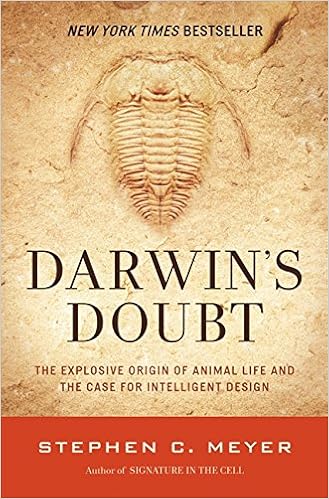
This Masterpiece is Stephen Meyer's follow up to the acclaimed book 'Signature in the Cell'. Meyer's central thesis is that, due to the indisputably short time frame for the Cambrian explosion (a blink of the eye in the earth's history), only intelligence is capable of producing such innovation. It doesn't appeal to evolutionary stories about how it must've been possible because it happened (the universe doesn't have the probabilistic resources to support such a view - as he shows). He uses a legitimate mode of scientific reasoning used in the historical sciences - reasoning from multiple competing hypothesis - he makes an inference to the best explanation. In our every day experience it is only intelligence that has the ability to produce large scale structural innovation. In fact he shows that it is highly improbable and therefore physically impossible that a random process could've produced what took place in the Cambrian explosion.
Dr Meyer's goal is evidently to ensure that readers can grasp the science and significance of what he is saying. I loved the chapters dealing with the probabilities of random mutation producing macroevolutionary changes, dGRN's and how that highlights the difficulty of macroevolutionary changes occurring, the difference between mere order (in Chemistry & Physics) and specified complexity in Biology and lastly his walking us through how Intelligent Design is easily reconciled as a true Scientific Theory (despite the subjective & unprovable a priori assumption of materialists who would have us believe otherwise).
This book has my highest recommendation! It cuts through all the nonsense materialists want us to uncritically gobble up.
5/5
Additional thoughts (Borrowed Heavily from Darwin's Doubt, Signature in the Cell & The Design Revolution)
Why ID is not an argument from ignorance:
- First, the definition of an argument from ignorance: Arguments from ignorance occur when evidence against a proposition is offered as the sole (and conclusive) grounds for accepting some alternative proposition.
- The (total) inadequacy of proposed materialistic causes forms only PART of the argument for intelligent design.
- We also know from our everyday and repeated experience that intelligent agents can and do produce information rich systems: we have POSITIVE and EXPERIENCE-BASED knowledge of a cause that is sufficient to produce new specified information, namely, intelligence.
- Thus, when we encounter such information in the large biological molecules needed for life, we may infer - based on our KNOWLEDGE of established cause-and-effect relationships - that an intelligent cause operated in the past to produce the specified information necessary to the origin of life.
- for the preceding reasons, the design inference does not constitute an argument from ignorance. Instead, it constitutes an inference to the best explanation based upon our available knowledge.
- It no more constitutes an argument from ignorance than any other well-grounded inference in geology, archaeology, or paleontology—where present knowledge of cause-and-effect relationships guides the inferences that scientists make about the causes of events in the past.
To put this into a formal argument (which as formulated - according to how ID is inferred - does not constitute an argument from ignorance):
Premise One: Despite a thorough search, no material causes have been discovered that demonstrate the power to produce large amounts of specified information.
Premise Two: Intelligent causes have demonstrated the power to produce large amounts of specified information.
Conclusion: Intelligent design constitutes the best, most causally adequate, explanation for the information in the cell and the explosion of biological innovation present in the Cambrian explosion.
The only reason to reject this inference is due to a philosophical bias that accepts
only materialistic explanations - which is an unprovable world view.
Also, to say ID must provide a mechanism is simply untrue. The innovation that comes from intelligence does not reduce a mechanistic process - because innovation defies a mechanistic explanation by its very nature. Where as Neo-Darwinism proceeds from a mechanistic theory, hence its burden of proof to provide a mechanistic explanation for the Cambrian explosion and the origin of the first life. Which it has proven incapable of providing thus far - there are no detailed, testable models for how known material mechanisms can generate biological complexity - only a variety of wishful speculations.
Issues with the RNA-World Hypothesis:
With regard to the RNA-World hypothesis, here are some real difficulties facing the theory:
- RNA building blocks are hard to synthesise and easy to destroy.
- Ribosomes are a poor substitute for proteins.
- An RNA-based translation and coding system is implausible.
- As noted by Les, the RNA-World still doesn't explain the origin of genetic information.
This is just an overview that highlights some of the big issues. This is why the RNA-World is not considered a slam dunk explanation of the origin of life.
Really, the origin of life is just one "Big Bang" infusion of information. There is also the Cambrian explosion and human consciousness which both currently defy plausible explanation.
Random thoughts on Neo-Darwinism:
Well there's really nothing convincing to say about Neo--Darwinism - if it didn't have the emotional implications that it has it surely would've gone to the wayside by now. The emotional element to this theory is why we should use critical thinking skills when analysing it. Sure scientists do little experiments that affirm what we already know the power of evolution to be - quite modest and they write theoretical books of course that postulate various evolutionary scenarios that don't congrue with the data.
Neo-Darwinian reasoning-->
Neo-Darwinian: "[insert either of two contradictory scenarios
/ modest example of evolution / hypothetical extrapolation from modest example of evolution (and use technical yet ambiguous language); here] proves Neo-Darwinian evolution!"
Critic: "No it does not *for such and such an evidential reason*".
**the debate continues in same course for a time**
Neo-Darwinian: *backtracks / takes the contradictory position as default / appeals to hypothetical future discoveries*.
Critic: *calls them out on the additional nonsense*.
Neo-Darwinian:*calls opponent a creationist who doesn't understand science / incorrectly asserts that there's no evidence for ID / mischaracterises ID by using a fallacy of some sort / rants about their own philosophical understanding of what makes something scientific and why they must be wrong (in a metaphysical sense - not in any way that appeals to evidence - of course)*.
Critic: *le sigh*.
Fin.
Review of Undeniable by Douglas Axe
This breakthrough book has been a great read. It explores how our design intuition when applied to nature is valid and how everyone can feel confident that those intuitions (having been sharpened you the points enumerated in the book) are correct. He shows us examples of design in nature and helps us to understand why.
Can alphabet soup, when the lid is removed from the pot, reveal complete instructions for building something new and useful? Clearly no. Well that illustrates the problem of the Neo-Darwinian explanation for the emergence of life from a primordial soup (or really any proposal of how the first life could've come about). This brings Axe to the principle of the Universal Design Intuition: "Tasks that we would need knowledge to accomplish can be accomplished only by someone who has that knowledge." This, he asserts, "...[is] the common human faculty by which we intuit design." His purpose thenceforth is to show that this intuition is reliable and provides a solid refutation to Darwinian explanations for life.
Axe shows us that the are many more possibilities than are likely to play out in reality. Why? Because our universe is bound by finite probabilistic resources. Darwinism appeals to blind searches to achieve certain outcomes. But he shows that appeals to chance severely downplay the likelihood of such a outcome taking place in reality.
Living things are exquisite wholes - an intricate interplay of overlapping levels of function - they are functionally coherent. Axe uses this fact to show why blind processes (required by Darwinism) fail in achieving the level of complexity present in living systems. "What enables human inventions to perform so seamlessly?" Axe asks. It is a thing called "functional coherence" - which, as Axe writes, is "the hierarchical arrangement of parts needed for anything to produce a high-level function - each part contributing in a coordinated way to the whole." He then goes on to show how this functional coherence "makes accidental invention fantastically improbable and therefore physically impossible."
He provides fascinating examples of biological systems, such as the Cyanobacteria & the Mammalian eye and shows us a basic overview (to go much deeper would require a book length treatments) of their intricate functional hierarchy. Axe writes, "unlike human inventions, living inventions are all-or-nothing wholes. Every cell in every body sustains both the body and is sustained by the body. Life is never anything but whole." Truly, this is mind boggling complexity.
This point I loved, to quote Axe, "each new form of life amounts to a new high-level invention, the origin of the thousandth new life form is no more explicable in Darwinian terms as the origin of the first." As an example, even if we were to suppose the first insect has been formed by chance, all the countless insects that differ substantially from the first would still be new top-level inventions - a great many of these components would have to be reworked to suit each new insect. This would have to be a "staggering feat of re-engineering in itself, to say nothing of that great new variety of new components that would have to be invented by scratch." A point downplayed by Darwinists.
Axe also shows us how we can use a practical tool, a "magicians hat" for analysing some of the fantastic claims made by Darwinists.
He shows how we can attribute this complexity, our design intuition, to an intelligent designer! In all, a great book! Highly recommended!
5/5
Subscribe to:
Posts (Atom)